Packaging has a vocabulary all of its own, and it can make a simple decision feel needlessly technical. "Do you want a reverse tuck or a crash-lock?" is a reasonable question from a supplier and a baffling one to a first-time buyer. This glossary sets out the common box constructions in plain English, with the practical trade-offs, so you can talk to any packaging supplier with confidence and choose the right shape for what you are selling.
Folding cartons: the flat-pack workhorses
Folding cartons are made from a single layer of thin board — the material of cereal boxes and cosmetics packaging. They ship flat and fold up at the point of packing. Within that family, the difference is almost entirely in how the ends close.
Straight tuck end (STE)
Both the top and bottom flaps tuck in from the same side, so the seams line up on the back. It looks clean from the front and is a sound default for retail products where the face of the box is what customers see. Best for lighter contents.
Reverse tuck end (RTE)
The top and bottom flaps tuck in from opposite sides. It uses slightly less board and is a touch cheaper to make than a straight tuck, at the cost of the seams sitting on both faces. Widely used and perfectly respectable for most retail goods.
Crash-lock base (auto-bottom)
Here the base is pre-glued so that when you pop the box open, the bottom folds and locks itself shut in one motion. If you are packing dozens or hundreds of units by hand, a crash-lock base is a genuine time-saver and it holds more weight securely than a tucked base. The trade-off is a slightly higher unit cost because of the gluing. For anything with a bit of heft — jars, bottles, candles — it is usually worth it.
Snap-lock (1-2-3) base
A manually interlocking base with no glue. Cheaper than a crash-lock and fine for lighter products, but it takes a moment longer to assemble and is not quite as secure under load.
Corrugated boxes: strength for transit
Corrugated board has a fluted middle layer that gives it its strength, which makes it the material of choice for anything that has to survive a courier network.
Mailer box (roll-end tuck-front)
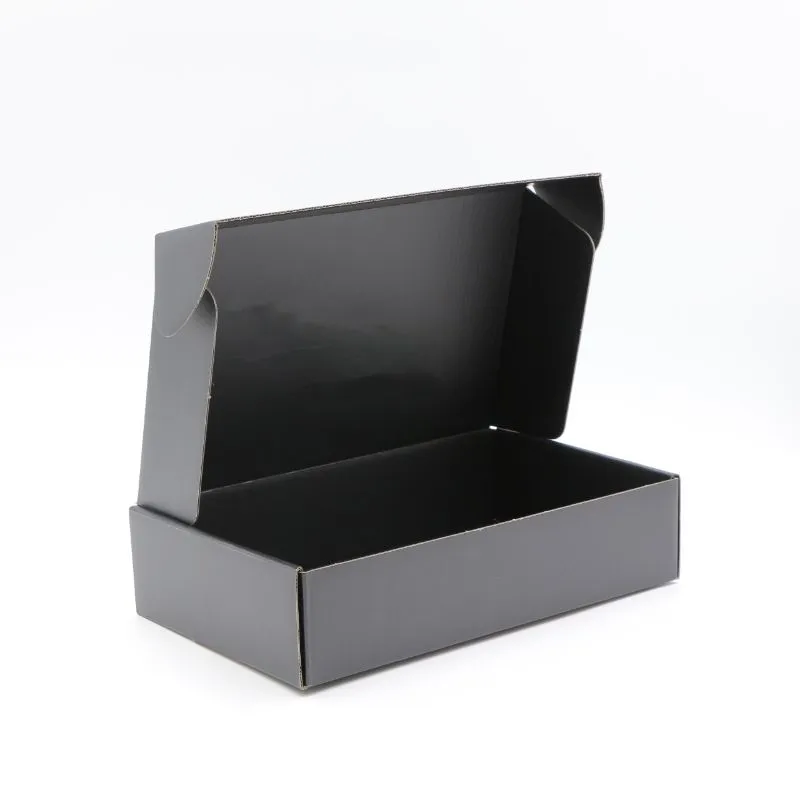
Die-cut from a single sheet, folding together without tape, with a lid that tucks into the front wall. Mailers open like a book and are the standard choice for e-commerce and subscription boxes where the unboxing matters. We have compared them directly with plain transit cartons in our piece on mailer boxes versus shipping boxes, which is worth a read if you sell direct to consumers.
Regular slotted carton (RSC / 0201)
The classic taped shipping box: four flaps top and bottom that meet in the middle. It is the cheapest way to put board around a product, stacks well, and in double-wall form takes real punishment. Utilitarian rather than pretty, but unbeatable for wholesale and heavy goods.
Die-cut corrugated cartons
When a plain slotted box will not do, corrugated can be die-cut into almost any shape — self-locking trays, display bases, boxes with integrated handles. More expensive than a standard RSC, but useful where a stock shape does not fit the job.
Sleeves, wraps and rigid boxes
Sleeve
A simple band of board or card that slides over a tray or another box. Sleeves are cheap, use little material, and are a smart way to add branded print to an otherwise plain inner — common on ready meals, gift sets and subscription trays. They also let you refresh seasonal artwork without re-tooling the whole box.
Book-style / magnetic-closure box
A rigid box with a hinged lid that opens like a book, often held shut with hidden magnets. This is premium territory — the kind of presentation used for high-value gifting and electronics.
Rigid (set-up) box
Made from thick greyboard wrapped in printed paper, rigid boxes are the stiff, heavy boxes you associate with luxury goods. They do not fold flat and cost considerably more, but nothing else feels the same in the hand. If you are weighing up whether the expense pays off, our article on whether luxury rigid boxes are worth it looks at the maths honestly.
How to choose without overthinking it
- Retail shelf, light product: a straight or reverse tuck folding carton.
- Retail shelf, heavier product: a crash-lock base carton.
- Shipping direct to customers, presentation matters: a mailer box.
- Bulk transit or wholesale: a regular slotted carton, single or double wall.
- Adding branding to a plain inner: a printed sleeve.
- Premium gifting: a rigid or magnetic-closure box.
A note on mixing styles
Few product ranges settle on a single construction. A brand might use tuck cartons for its lighter lines, crash-lock bases for the heavier ones, mailers for direct orders and plain slotted cartons as transit outers for wholesale. That is not indecision — it is matching each box to its job, and it keeps you from over-paying on the simple items while still presenting the flagship products well. Ordering the whole set from one supplier keeps colours, board and print quality consistent across the range, which matters more than buyers expect when a customer sees two of your boxes side by side.
It also pays to think about assembly. A crash-lock base folds up in one motion, which is a real time-saver if you pack by hand in any volume; a snap-lock or tucked base is cheaper to buy but slower to build. When you are packing dozens of units an evening, that difference in seconds per box turns into hours across a month. Weigh the unit-cost saving against your own labour before defaulting to the cheapest base.
If your product sits awkwardly between two of these, that is normal — plenty do. You can see the constructions in the flesh across our portfolio, and if you tell us what you are packing and how it will travel, we will recommend a style honestly when you request a quote, including the cheaper option where it does the job just as well.